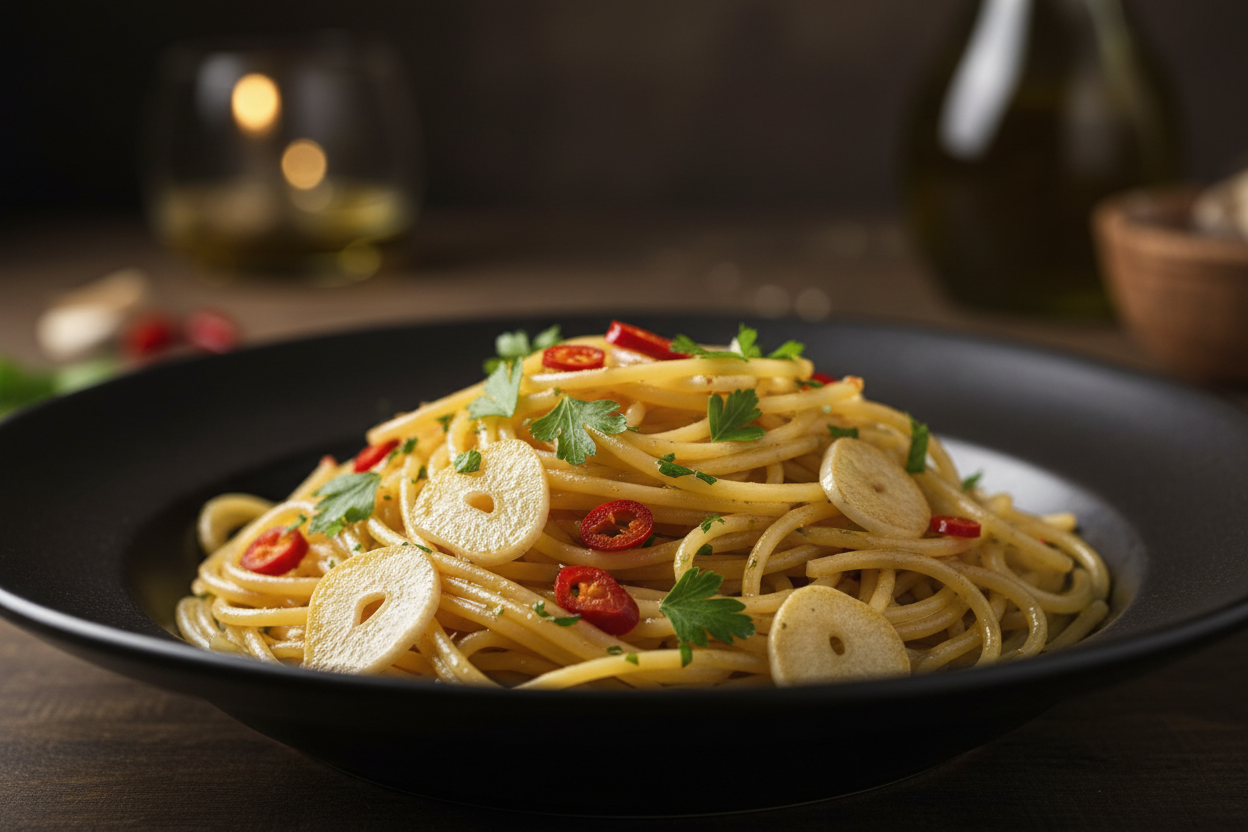
Pasta Aglio e Olio Recipe — The Purest Expression of Great Olive Oil in Pasta
Pasta aglio e olio is one of the most honest dishes in Italian cooking. Four ingredients. Twenty minutes. Nowhere to hide. The garlic matters. The pasta water matters. But more than anything else — the olive oil is the sauce. Which means the olive oil is everything.
This is the version we make with Oilala Coratina, and it is something else entirely. Coratina is one of the most intensely flavoured olive oil varieties in the world — bold, peppery, with a long finish that hits the back of your throat in the best possible way. In a dish this stripped back, that character doesn't get lost. It gets amplified.
How I Learned to Make This Properly
I'll be honest — I thought I knew how to make aglio e olio. Garlic in oil, pasta in, done. It was fine. It was always just fine.
Then I fell down a rabbit hole watching Frank Prisinzano cook on Instagram. If you don't know Frank, he's a New York chef — owner of Frank, Lil' Frankie's, and Supper in the East Village — and he is one of the most vocal, passionate advocates for Coratina olive oil you'll find anywhere. He doesn't just use it. He talks about it the way other people talk about wine vintages. He's obsessed, and watching him cook made me obsessed too.
The connection came through Spiros, who tends the Oilala farm back in Puglia and had already been supplying Frank's restaurants. When Spiros mentioned I was bringing in oil fresh from the harvest — Coratina airlifted in December, barely weeks after the olives came off the trees — Frank wanted some. So on two separate occasions, once to his restaurant and once to his home, I hand-delivered it personally. As fresh as extra virgin olive oil gets. He loved it, posted about it on Instagram (which gave us a very welcome bump in sales), and that was that. A friendship built on good oil.
What Frank taught me — through watching him work rather than any direct conversation — is that the emulsification is the whole game. The pasta water isn't a trick or a tip. It's the technique. The starch in that water is what binds the oil into a sauce rather than leaving it as a puddle at the bottom of the bowl. You have to toss hard, keep the heat low enough that the garlic never browns, and use enough oil that you feel slightly uncomfortable about it. That's when you know you're doing it right.
He's also a huge Oilala Coratina fan — and once I started using it in this dish, I understood exactly why. The peppery, grassy intensity of Coratina holds up to the garlic in a way that a milder oil simply doesn't. A delicate Ligurian oil would get swallowed. Coratina pushes back. It's a conversation between the ingredients, not one overpowering the other.
Why Coratina Is the Right Oil for This Dish
Coratina is a cultivar native to the Puglia region of southern Italy — one of the most polyphenol-rich olive varieties in the world. High polyphenols mean high antioxidant content, a longer shelf life, and that characteristic bitterness and peppery finish that makes the oil so distinctive.
In cooking terms, that intensity means Coratina can stand up to bold flavours — garlic, chilli, anchovies, bitter greens — without disappearing. In a dish like aglio e olio, where the oil is literally the sauce, you want an oil with presence. You want to taste it.
Oilala Coratina is cold-extracted from early-harvest Coratina olives, which pushes the polyphenol content even higher and gives the oil that vivid green, almost grassy character. Finish a bowl of pasta with it and you'll feel that gentle burn at the back of your throat — that's the oleocanthal, the same compound that gives ibuprofen its effect. It's a sign of quality, not a flaw.
Ingredients
- 200g spaghetti or spaghettoni
- 8 tbsp Oilala Coratina EVOO (plus more to finish — don't be shy)
- 6 garlic cloves, thinly sliced
- 1 tsp dried red chilli flakes (or more, to taste)
- Large handful fresh flat-leaf parsley, roughly chopped
- Flaky sea salt
- Reserved pasta cooking water — at least 1 full cup, kept hot
Serves 2. Scale up as needed — just keep the oil-to-pasta ratio generous.
Method
- Salt your water properly. It should taste like the sea. This is the only seasoning the pasta itself gets, and it matters more than people think.
- Cook the spaghetti until just al dente — it will finish cooking in the pan, so pull it a minute early. Before you drain it, scoop out at least a full cup of the starchy cooking water and keep it hot.
- Warm the Oilala Coratina in a wide, heavy pan over medium-low heat. Add the sliced garlic and cook gently, stirring occasionally, until it turns pale golden — about 3 to 4 minutes. Watch it carefully. The moment it starts to brown, the flavour turns bitter and the dish is compromised. Low and slow.
- Add the chilli flakes and cook for another 30 seconds, letting them bloom in the oil.
- Add the drained pasta directly to the pan along with a generous splash of the hot pasta water — start with about half a cup.
- Toss vigorously. This is the Frank Prisinzano move — keep the pan moving, keep tossing, and watch the starchy water emulsify with the oil into a light, glossy sauce that coats every strand. Add more pasta water as needed to keep it loose and silky. The sauce should look almost creamy.
- Remove from heat. Add the parsley and toss once more.
- Serve immediately in warm bowls and finish each portion with another pour of Oilala Coratina straight from the bottle. This is not optional. This is the point.
Cook's Notes
The pasta water is not a garnish — it's the technique. Without it, you have oily pasta. With it, you have a sauce. The starch is the emulsifier. Use it generously and keep it hot.
Don't brown the garlic. Golden is the target. Brown is a mistake. If it goes too far, start again — it's worth it.
Use more oil than feels reasonable. This dish is not trying to be light. It is trying to be perfect. Eight tablespoons is a starting point, not a ceiling.
Finish with raw oil. The oil you cook with and the oil you finish with are doing different jobs. The cooked oil builds the sauce. The raw oil you pour over at the end is where you taste the Coratina at its most vivid — grassy, peppery, alive. Don't skip it.
Spaghettoni over spaghetti if you can find it. The thicker strand holds the sauce better and gives you more to work with in the toss.
Variations Worth Trying
With anchovies: Add 3–4 oil-packed anchovy fillets to the pan with the garlic and let them melt into the oil. They dissolve completely and add a deep, savoury backbone without tasting fishy. This is arguably the better version.
With breadcrumbs: Toast coarse breadcrumbs in a separate pan with a little Oilala Coratina until golden and crisp. Scatter over the finished pasta in place of — or alongside — parmesan. The crunch is excellent.
With lemon: A little lemon zest added at the end brightens the whole dish and plays beautifully against the pepper of the Coratina.
The Oil Is the Recipe
There's a reason this dish has survived for centuries in its simplest form. It doesn't need improvement. It needs respect — for the technique, for the ingredients, and above all for the oil.
Watching Frank Prisinzano cook taught me that the best Italian cooking isn't about complexity. It's about understanding what each ingredient is doing and giving it the space to do it properly. In aglio e olio, the olive oil isn't a background player. It's the lead. Choose accordingly.

Written by Raphael Bondi

Leave a comment
This site is protected by hCaptcha and the hCaptcha Privacy Policy and Terms of Service apply.