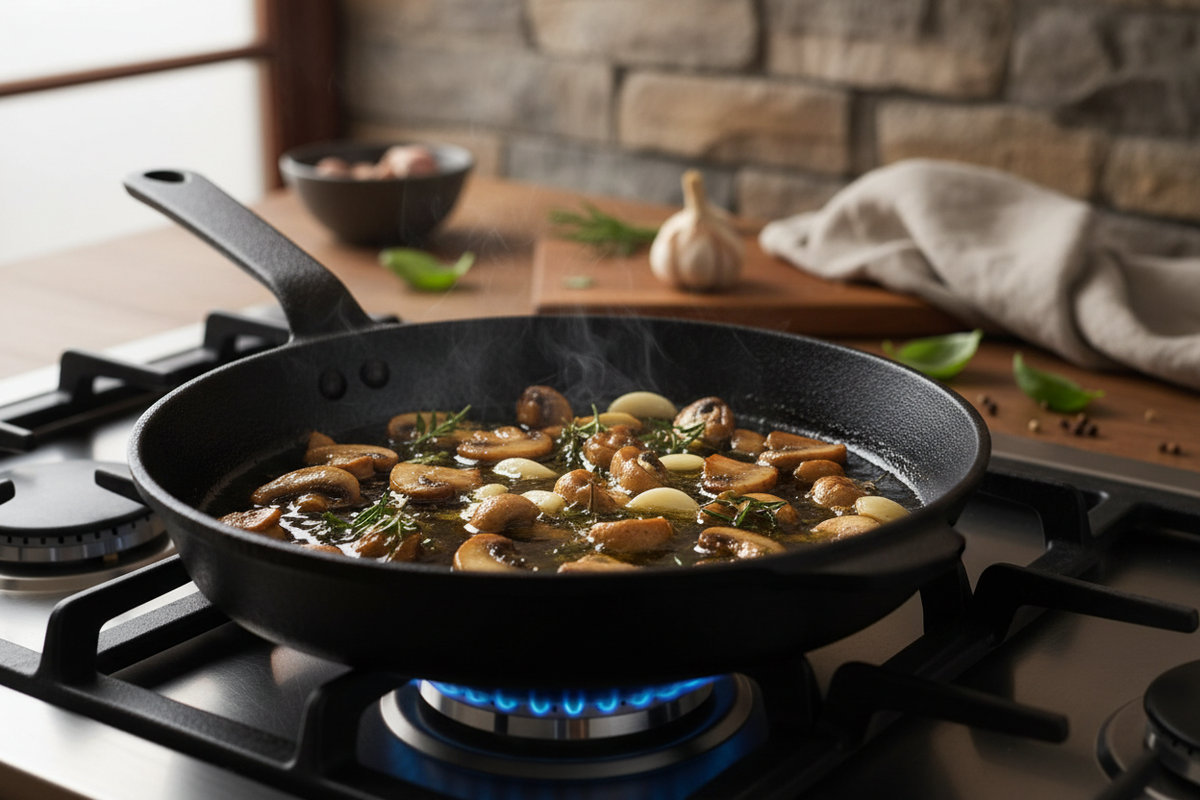
Can You Cook With Extra Virgin Olive Oil? A Practical Guide to Smoke Point
This article reflects my own opinion and the way I cook. It is not medical advice, and the smoke-point conversation is still a lively one.
Can you cook with extra virgin olive oil? I do, including at higher heat. Yet one warning comes up again and again: “Don’t cook with extra virgin olive oil. Its smoke point is too low.” It is repeated so often that it can sound like settled fact. It isn’t that simple.
Olive oil smoke point matters, but it is only one part of the story. Extra virgin olive oil’s long history in Mediterranean cooking, its naturally occurring antioxidants, and the way real people have used it in kitchens for generations matter too. My bottom line is straightforward: with the information we have, I feel comfortable cooking with good EVOO, including at higher heat.
What is the smoke point of extra virgin olive oil?
The smoke point is the temperature at which an oil begins visibly smoking. Once oil is smoking, it can taste unpleasant and produce compounds you would rather not serve. That is true of olive oil, butter, avocado oil, seed oils, and any other cooking fat.
The exact smoke point of extra virgin olive oil is not a fixed number. It varies with the oil’s freshness, free fatty-acid level, refinement, and quality. A well-made EVOO can be entirely practical for sautéing, roasting, baking, pan-frying, and everyday stovetop cooking. The useful rule is not “use EVOO for everything at maximum heat no matter what.” It is: do not let any oil sit in a pan until it is billowing smoke.
Is extra virgin olive oil good for high-heat cooking?
For everyday cooking, I believe it is. There are real questions worth discussing. Heat changes food, and it changes oils too. Some components are reduced with cooking, including some of the delicate flavors and certain naturally occurring compounds that make a fresh extra virgin olive oil special. That is not controversial.
What people disagree about is what those changes mean in a real kitchen. Some emphasize the loss of nutrients or antioxidants and recommend reserving EVOO for finishing. Others point to olive oil’s composition, antioxidant content, stability in cooking tests, and long culinary history as reasons it can hold up well when heated. Both sides can find studies and talking points, which is why a clean, dramatic answer rarely tells the whole truth.
My view is that at worst, heating EVOO may strip away some of what makes it exceptional in its raw form. At best, plenty remains. Either way, I do not see ordinary, sensible cooking with EVOO as something inherently unhealthy.
Why olive oil smoke point is still a raging debate
Smoke point is easy to measure and easy to turn into a headline. But cooking oils are more complicated than one number. How hot the pan gets, how long the oil is exposed to heat, whether it is repeatedly heated, and the oil’s starting quality all matter.
Extra virgin olive oil is not a new cooking trend looking for a reason to belong in the pan. It has been used across Mediterranean kitchens for a very long time, not only as a finishing drizzle but for vegetables, fish, sauces, eggs, braises, baking, and frying. That longevity does not replace scientific research, but it is meaningful context.
The Mediterranean way of eating is also more than one ingredient. It is a pattern built around vegetables, legumes, grains, seafood, meals cooked at home, and generous use of olive oil. Still, when I look at that history alongside the lack of a convincing practical downside to using EVOO below its smoking point, I see a strong case for keeping it in the pan.
Why I cook with EVOO instead of seed oils
This is where my personal preference comes in. I am more comfortable making extra virgin olive oil my default cooking fat than relying on refined seed oils. Opinions and evidence around seed oils are contentious too, and I am not claiming that every seed oil is automatically dangerous or that one cooking choice decides anyone’s health.
But when I can choose a fresh, well-made extra virgin olive oil with a long food tradition, recognizable flavor, and naturally occurring antioxidants, that is the choice I make. I would rather build my cooking around an ingredient I know, enjoy, and can taste than chase a single smoke-point number on a chart.
How to cook with extra virgin olive oil
I use EVOO for sautéing onions and garlic, roasting vegetables, cooking eggs, searing fish, baking, and making sauces. I let the food guide the heat. Medium to medium-high heat is often plenty. If the oil begins smoking aggressively, I lower the heat, start over if needed, and avoid turning the pan into a science experiment.
For an oil with enough character for both cooking and finishing, explore our Oilala Coratina extra virgin olive oil. For the most delicate and expressive oils, I save some for the moment that shows them off best: drizzled over soup, grilled vegetables, beans, pasta, bread, or a finished plate of fish. Cooking with EVOO brings flavor into the dish; finishing with it lets its aroma and personality speak clearly.
The bottom line on cooking with olive oil
We should do our best to make the best choices possible with the information we have, while staying honest about what we do and do not know. For me, that means not being afraid of extra virgin olive oil in the kitchen.
Yes, heat can reduce some of the oil’s prized raw qualities. Yes, smoke point is worth respecting. But the debate is bigger than one temperature. Given EVOO’s historical use, its place in the Mediterranean diet, its performance in real cooking, and what I see as no clear downside when it is used sensibly, I cook with it, even at higher heat. Then I reach for another pour at the table, because great olive oil deserves the final word too.
Further reading
For readers who want to dig further into olive oil and dietary patterns, two useful starting points are the Harvard T.H. Chan School of Public Health overview of olive oil and the UC Davis Olive Center research library. These resources offer broader context, while this article remains my personal, practical view from the olive-oil business and my own kitchen.
About Raphael
Raphael has worked in the extra virgin olive oil business for several years. He writes from the perspective of a retailer and everyday cook, with a focus on helping people choose, use, and enjoy better olive oil.

Leave a comment
This site is protected by hCaptcha and the hCaptcha Privacy Policy and Terms of Service apply.